
Monochrome Printing: Definition, How It Works, and Benefits
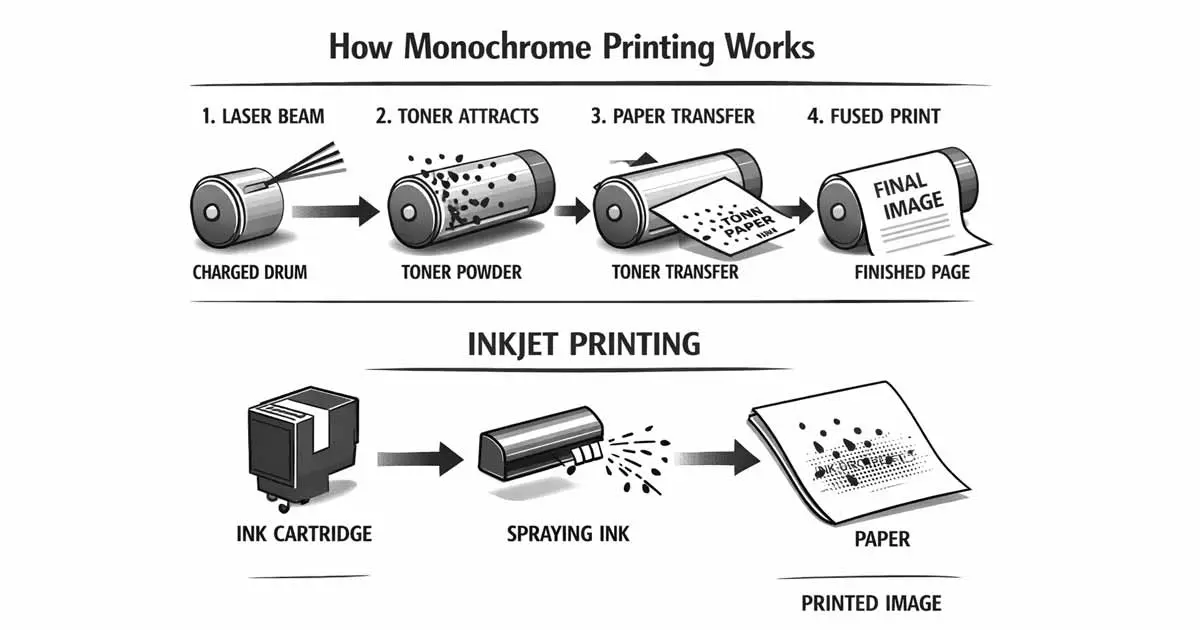
Monochrome printing remains a cornerstone of efficient and professional document production. By using a single ink or toner color, most often black, this method delivers sharp, high-contrast prints suitable for offices, schools, and legal environments. Beyond simplicity, monochrome printing offers cost savings, speed, and reliability, making it a practical choice for high-volume and formal printing needs.
What is Monochrome Printing?
Definition: Monochrome printing refers to the process of producing printed materials using only a single color of ink or toner. While black is most common, other colors like white, gold, or silver can also be used depending on the application.
- In photography and graphic design, monochrome images may use only pure black and pure white, often without gray shades.
- In printing, monochrome refers to using a single ink or toner color across the entire document or image.
How Monochrome Printing Works
Monochrome Laser Printers
Monochrome laser printers operate by projecting a laser beam onto a drum, which attracts toner particles and transfers them to paper using heat. This process produces sharp, high-contrast text and images with consistent quality. Laser printers are highly efficient, offering fast printing speeds and a low cost per page, making them particularly suitable for offices with large volumes of text-based printing.
Monochrome Inkjet Printers
Monochrome inkjet printers work by spraying a single color of ink onto paper in precise patterns. They are capable of producing high-quality text and images and are well-suited for smaller-scale or specialized printing tasks. While versatile, inkjet printers may be less cost-effective than laser printers for high-volume monochrome printing due to higher ink consumption and slower output.
Monochrome Ribbon Printing (Specialized Applications)
Monochrome ribbon printing is commonly used for card or label production, where ribbons contain only one color panel. To achieve optimal results, it is important to follow best practices: use high-contrast images, remove or match background colors, save edited images in formats that preserve transparency such as PNG, and convert images to monochrome format using compatible software like CardPresso or Edikio Studio. Proper preparation ensures that prints are clear, accurate, and professional in appearance.
Benefits of Monochrome Printing
Monochrome printing provides practical and efficient solutions for businesses and offices. It combines cost savings, speed, and professional output in a reliable format. Key advantages include:
Cost Efficiency: Using a single-color toner or ink is generally cheaper than maintaining multiple color cartridges, helping reduce overall printing expenses.
Speed and Simplicity: Monochrome printers typically operate faster than color printers and require minimal setup or maintenance.
Professional Appearance: Black-and-white printing conveys formality and is ideal for legal documents, contracts, reports, and official correspondence.
Reliability: With fewer components involved, monochrome printers have a reduced risk of errors, ensuring consistent and dependable output quality.
Choosing the Right Monochrome Printer
Selecting the right monochrome printer depends on your specific printing needs, including volume, quality, and application. Key considerations and tips include:
Considerations
- Printing Volume: High-volume offices typically benefit from the speed and efficiency of laser printers.
- Print Quality Requirements: Inkjet printers may be preferred for documents that require fine detail or high-resolution text and images.
- Specialized Applications: Card or badge printing often requires monochrome ribbons and compatible design software.
Tips
- Evaluate your primary printing tasks to determine which printer type best suits your workflow.
- Compare the total cost of ownership, including toner or ink costs and maintenance requirements.
- Ensure the printer supports the required document size, paper type, and any specialized media you plan to use.
In a Nutshell
In a nutshell, monochrome printing is a simple, cost-effective, and reliable solution for producing professional-quality documents. By using a single ink or toner color, it delivers sharp text and clear images while reducing printing expenses and maintenance needs. Whether for high-volume office work, detailed inkjet printing, or specialized card and badge applications, monochrome printing combines efficiency, speed, and consistency, making it a practical choice for businesses and organizations of all types.
Frequently Asked Questions
What is the difference between monochrome and color printing?
Monochrome printing uses only one color, typically black, while color printing combines multiple inks or toners to produce full-color images and documents.
Can monochrome printers print in colors other than black?
Yes. Some applications allow gold, silver, or white inks, especially in card or specialty printing.
Are monochrome printers more cost-effective than color printers?
Generally, yes. Toner cartridges for monochrome printers are less expensive, and maintenance is simpler.
What types of printers are used for monochrome printing?
The most common types are laser printers, inkjet printers, and ribbon-based printers for cards or labels.
How do I ensure high-quality prints with a monochrome ribbon printer?
Use high-contrast images, remove backgrounds, save in PNG format for transparency, and convert images to monochrome using compatible design software.

Jennifer James
My specialty is developing cost-effective, attractive, and appropriate packaging for protecting products. I am working with the company to design custom packaging that meets the client’s requirements.
5 Responses