
DTF vs Screen Printing: Choosing the Best Print Method for Your Project
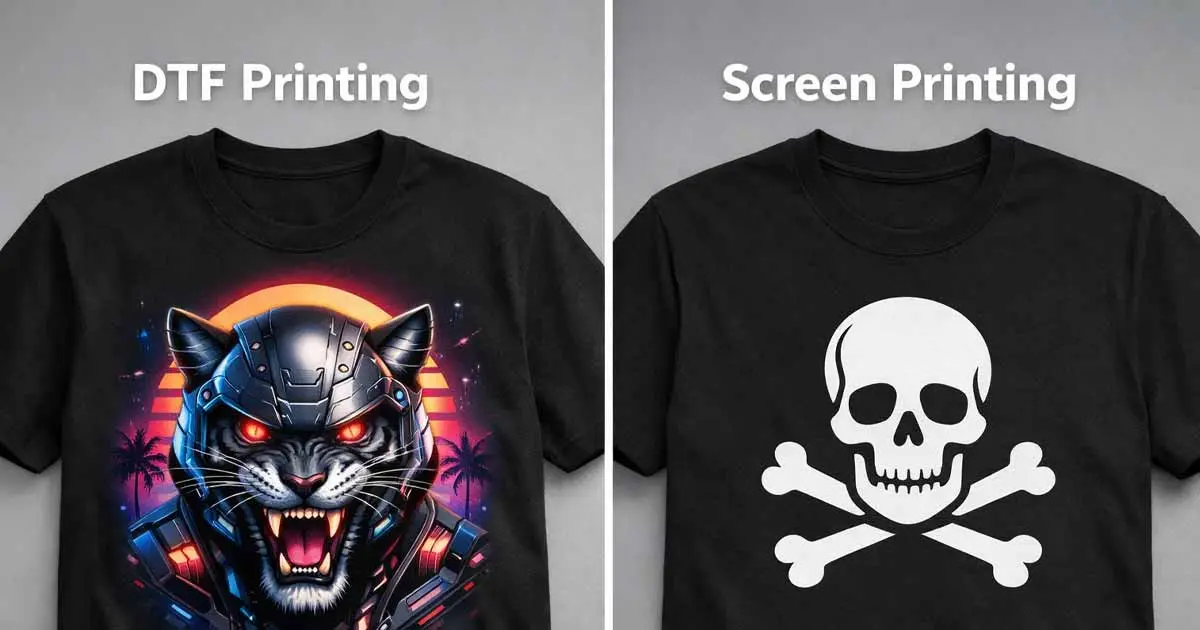
Choosing the right printing method is crucial for any project, brand, or small business. Two of the most popular options, DTF (Direct-to-Film) printing and screen printing, offer distinct advantages depending on your design, material, and order size. Understanding their differences can save time, reduce costs, and ensure professional-quality results.
What Is DTF Printing?
Direct-to-Film (DTF) printing is a digital printing method where designs are printed onto a special transfer film using water-based pigmented inks, coated with adhesive powder, and heat-pressed onto fabric.
Advantages of DTF Printing
- Handles complex, multicolor designs in one pass.
- Works on various fabrics, including cotton, polyester, and blends.
- Requires lower setup costs, ideal for small batches or one-off orders.
- Produces soft, smooth prints that are durable with proper care.
Typical DTF Equipment
Direct-to-Film (DTF) printing requires several specialized pieces of equipment to produce durable, high-quality transfers. A DTF printer is used to print the design onto a special transfer film, typically using CMYK inks along with white ink to maintain vibrancy and opacity on different fabrics. Once printed, the design is coated with adhesive powder, often applied with a shaker, which ensures the print adheres firmly to the garment during heat application. The design is then transferred to the fabric using a heat press, which applies consistent heat and pressure to embed the ink and adhesive into the material. Together, the printer, transfer film, inks, adhesive powder, and heat press form the essential components of a complete DTF setup.
What Is Screen Printing?
Screen printing is a traditional method using stencils (screens) for each color in a design. Ink is pushed through the screens layer by layer onto the substrate.
Advantages of Screen Printing
- Excellent for large print runs with simple designs.
- Produces vibrant, long-lasting colors.
- Cost-effective for bulk orders due to economies of scale.
Challenges
Screen printing presents several challenges that can affect both cost and efficiency. One of the primary drawbacks is the higher setup cost, which arises from creating screens for each color and the labor involved in preparing the design. Additionally, the process is slower for multi-color designs, since each color requires a separate screen and must be applied sequentially. Screen printing also has limited versatility when working on dark or textured fabrics, often necessitating the use of special inks or a white underbase to ensure the design appears vibrant and accurate. These factors make screen printing less flexible compared to some modern printing methods, particularly for small runs or complex designs.
DTF vs Screen Printing: Key Comparisons
When choosing between DTF and screen printing, understanding their strengths and limitations is essential for selecting the right method. The following comparisons highlight differences in cost, design flexibility, material compatibility, and overall performance.
Setup Cost
One of the main differences between DTF (Direct-to-Film) printing and traditional screen printing is the initial setup cost. DTF printing generally has a lower setup cost, making it ideal for small batches and on-demand production. Screen printing, by contrast, involves higher expenses due to the need for multiple screens and more labor-intensive preparation, making it more suitable for large-volume runs where costs can be amortized over many items.
Design Complexity
DTF excels at handling intricate and multi-color designs without additional effort. Because all colors can be printed simultaneously onto the transfer film, even highly detailed graphics maintain accuracy. Screen printing is more limited in this regard, performing best with simple designs or a small number of colors, as each color requires its own screen and careful alignment.
Material Versatility
When it comes to material compatibility, DTF offers greater versatility. It can print effectively on dark, light, and textured fabrics without requiring complex underbases, whereas screen printing often necessitates special inks or a white underbase to ensure designs appear vibrant on darker materials.
Turnaround Time
Speed of production is another area where DTF has an advantage. Because the entire design can be printed at once, turnaround times are generally faster. Screen printing is slower, especially for multi-color designs, since each color must be applied sequentially and allowed to dry before the next layer.
Durability
Both methods produce long-lasting prints, but there are subtle differences in durability. Screen prints are considered very durable, though the layered ink can sometimes crack or fade over time, particularly on stretchable fabrics. DTF prints are also durable and maintain color fidelity, though they may be slightly less resistant to extreme wear than traditional screen printing.
Print Feel
The hand feel of the print is noticeably different between the two methods. DTF prints tend to be soft and smooth, offering a lightweight feel on the fabric. Screen printing, in contrast, results in a thicker, more textured layer of ink, which can be felt on the surface of the garment.
Environmental Impact
DTF printing has a relatively lower environmental impact because it typically uses water-based inks and produces minimal chemical waste. Screen printing, on the other hand, involves more chemical-based inks and additional cleaning agents, resulting in a higher ecological footprint.
Which Printing Method Is Better?
The choice depends on project type, order size, and design complexity:
- Choose DTF if:
- You need intricate, full-color designs.
- Printing on dark or textured fabrics.
- You want fast turnaround for small batches.
- Budget and setup cost are a concern.
- Choose Screen Printing if:
- You’re producing large quantities of identical designs.
- Designs are simple, bold, and few-colored.
- Maximum durability for repeated washes is critical.
Considerations for Small Businesses
- Startup Costs: DTF setups can start from desktop printers and heat presses, while screen printing requires multiple screens and a larger workspace.
- Inventory Management: DTF enables on-demand printing, reducing inventory risk.
- Customization & Scalability: DTF is ideal for personalized orders; screen printing scales better for bulk production.
- Maintenance & Safety: DTF uses water-based inks and minimal chemicals; screen printing requires chemical cleaners and proper ventilation.
In a Nutshell
DTF (Direct-to-Film) printing and screen printing are two leading methods for transferring designs onto fabric. DTF excels at intricate, full-color designs, works on a wide range of materials, and is ideal for small batches or custom orders. Screen printing is best for large runs of simple, bold designs, offering vibrant colors and long-lasting durability. Choosing between them depends on your project size, design complexity, material, and budget. Understanding these differences ensures the right method for high-quality, professional results every time.
Frequently Asked Questions
Can DTF or screen printing work on all fabrics?
DTF works on cotton, polyester, blends, and even dark fabrics. Screen printing is best on light, smooth surfaces; darker fabrics require a white underbase.
Which method is more environmentally friendly?
DTF uses water-based inks with minimal chemicals, making it more eco-conscious. Screen printing involves chemical cleaners and inks that may be less environmentally friendly.
How durable is DTF compared to screen printing?
Both methods are durable. DTF prints are soft yet long-lasting; screen prints can last decades but may crack if ink layers are thick.
Is DTF suitable for children’s clothing?
Yes, if non-toxic inks are used. Both DTF and screen printing can be compliant with OEKO-TEX or CPSIA standards.
Which method produces the best color reproduction?
DTF excels at reproducing complex, multicolor designs. Screen printing is excellent for bold, limited-color designs but less precise for fine details.

Jennifer James
My specialty is developing cost-effective, attractive, and appropriate packaging for protecting products. I am working with the company to design custom packaging that meets the client’s requirements.
5 Responses